








November 2026
Critical Annotated Edition
Hardcover with Dust Jacket
6″x9″ – 400 pages
Limited to 500 copies
ISBN 978-2-930011-21-9
Collection – Universalis
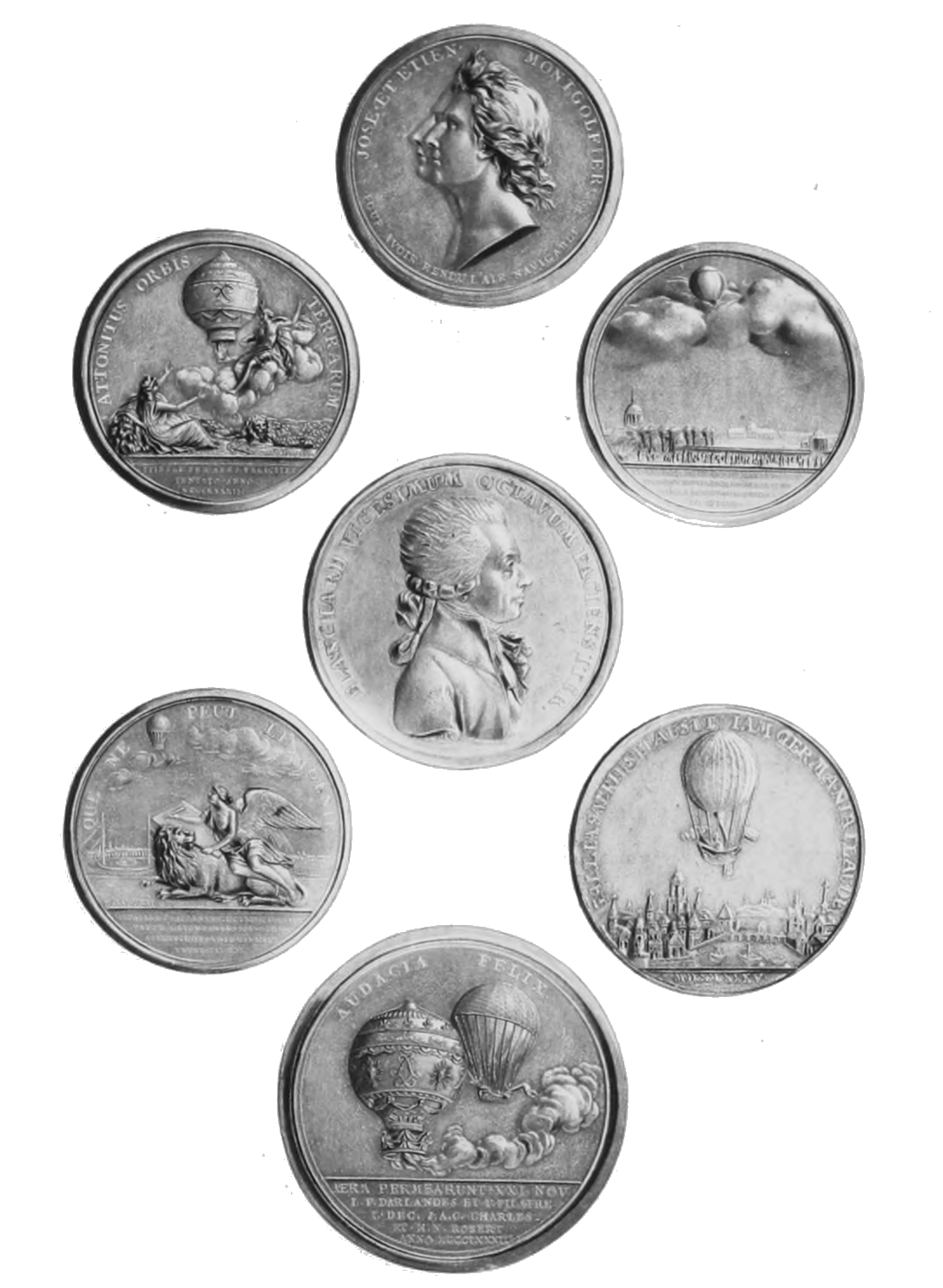
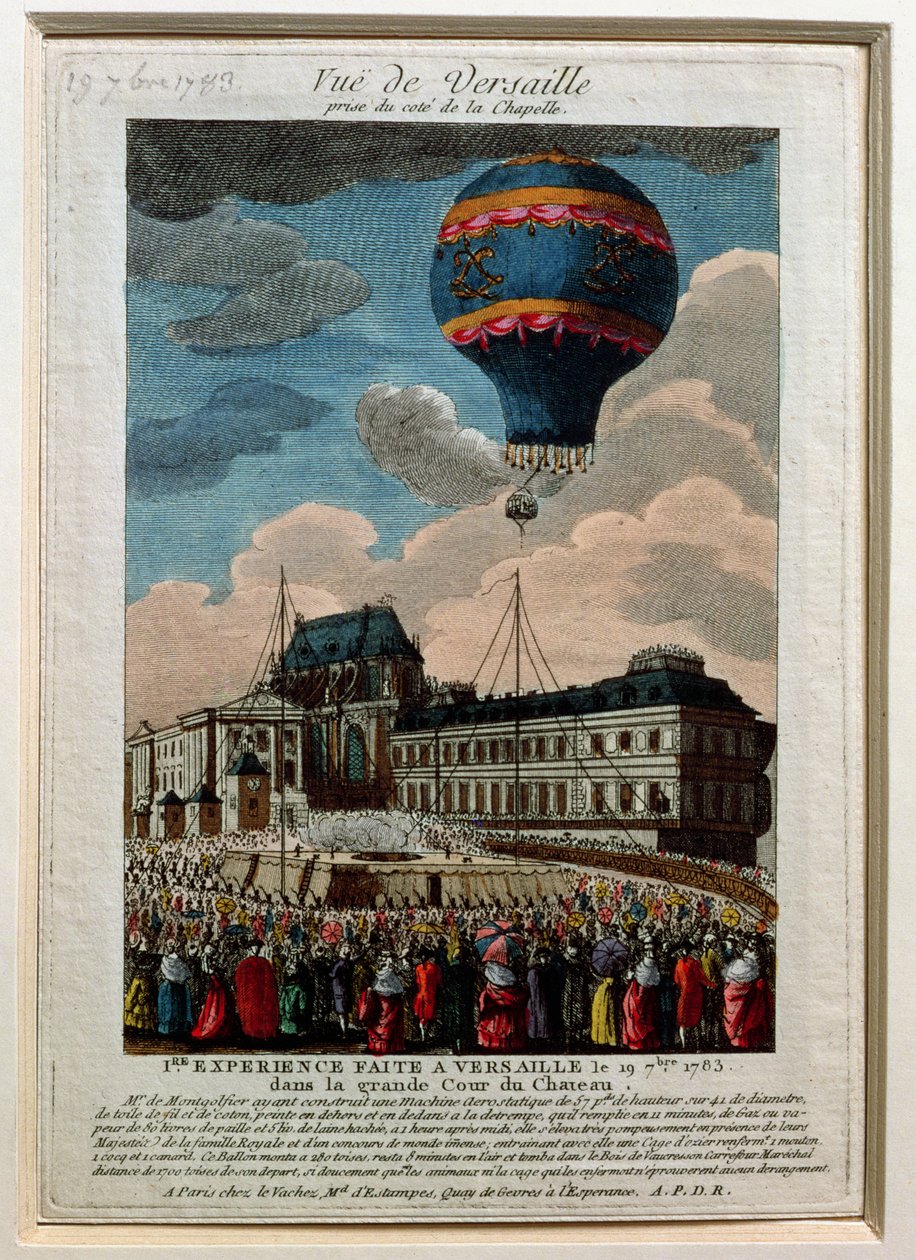
“From the first public ascent at Annonay on 4 June 1783, achieved by Joseph and Étienne Montgolfier, to the historic manned flight of Pilâtre de Rozier and the Marquis d’Arlandes on 21 November 1783, the conquest of the air became the work of many hands. On 1 December 1783, Jacques Charles and Nicolas-Louis Robert demonstrated the hydrogen balloon before the astonished crowds of Paris. Two years later, on 7 January 1785, Jean-Pierre Blanchard and Dr. John Jeffries crossed the English Channel, transforming experiment into international triumph”.
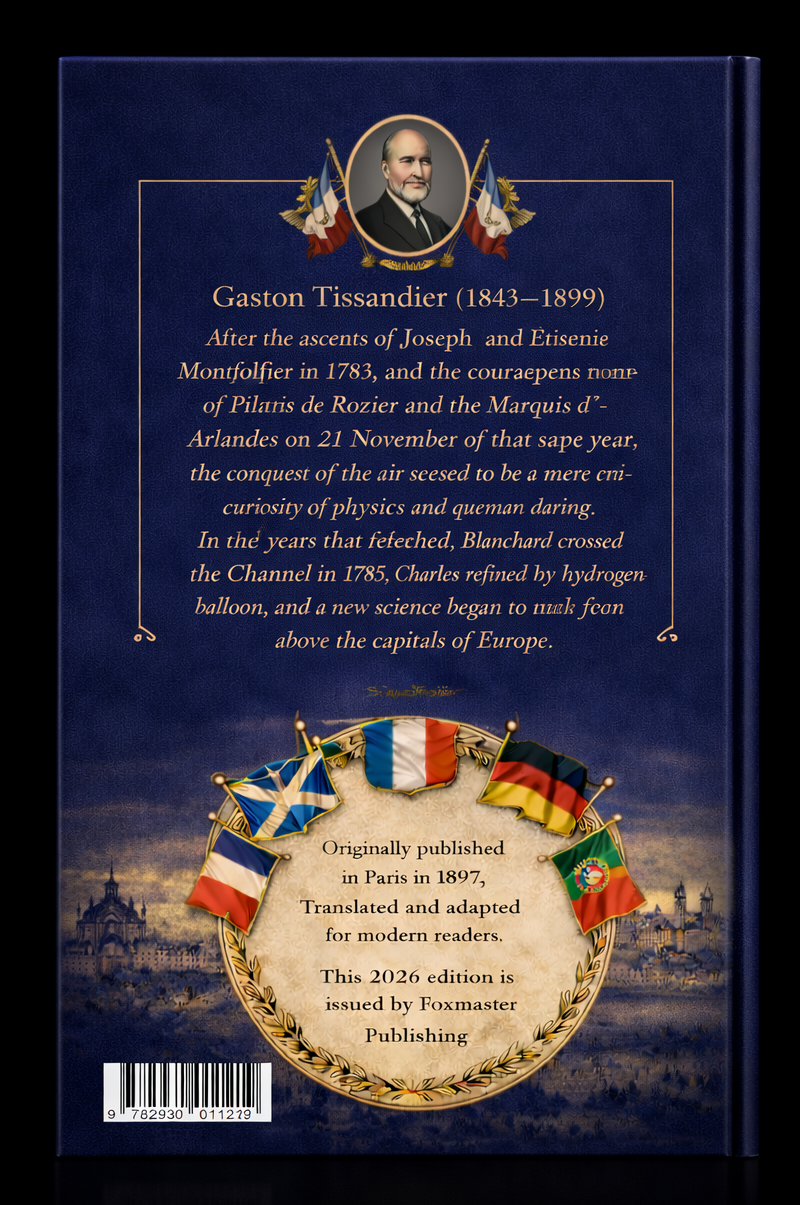
“After the ascents of Joseph and Étienne Montgolfier in 1783, and the courageous experiments of Pilâtre de Rozier and the Marquis d’Arlandes on 21 November of that same year, the conquest of the air ceased to be a mere curiosity of physics and became a question of human daring. In the years that followed, Blanchard crossed the Channel in 1785, Charles refined the hydrogen balloon, and a new science began to take form above the capitals of Europe”.
“After the numerous triumphs that had marked his career in Europe, Blanchard resolved to carry the art of aerostation beyond the Atlantic. The New World, scarcely initiated into the marvels of aerial navigation, awaited its first spectacle of this nature. On the 9th of January, 1793, before an immense concourse assembled at Philadelphia, the aeronaut rose majestically into the winter sky. The presence of General Washington lent to the enterprise a solemn and almost political character, as though the young Republic itself were sanctioning the conquest of the air. The balloon, borne southward by a steady current, traversed the Delaware and descended safely in the State of New Jersey, thus inaugurating in America that series of ascents which Europe had already learned to admire”.
This subscription is not conceived as a conventional commercial operation. Its purpose is not to sell books in the ordinary market sense, but to allow students, university researchers, and historians to obtain access to a scientifically translated and critically adapted edition of a foundational aeronautical work. The first printing is strictly limited to 500 copies.
For a small independent Belgian publishing house, producing a rigorously edited and annotated historical volume of this nature represents a substantial financial commitment. The subscription therefore serves as a means of making scholarly transmission possible — ensuring that this work may exist as a carefully prepared edition intended for serious study and long-term preservation.
Single Copy
49 € + Shipping (Flat Rate 30 €)
Regular Price after Publication: 79 €
Pre-Order
Reader: 60 € (was 79 €)
Reseller (10 Copies): 400 € (Shipping Included)
Regular Bundle: 490 € + 110 € Shipping
Offer valid until July 31, 2026 or until all 500 copies are sold


Europe
Single Copy
49 € + Shipping (Flat Rate 15 €)
Regular Price after Publication: 64 €
Pre-Order
Reader: 50 € (was 64 €)
Reseller (10 Copies): 350 € (Shipping Included)
Regular Bundle: 490 € + 45 € Shipping
Offer valid until July 31, 2026 or until all 500 copies are sold


This English edition of Gaston Tissandier’s work was born of a series of rather unusual circumstances. As founder and director of the European Center of Military History (eucmh.com), I was conducting research for a comprehensive volume on which I have been working since 2025. That book examines the use of parachutes in the military sphere during the period 1900–1945. While searching through archival materials and digital repositories, I encountered a document containing several references that proved highly relevant to my research.
At the same time, as often happens during long hours of archival work, I had a documentary playing in the background. A video claiming that researchers had rediscovered the aircraft of Amelia Earhart drew my attention. Following this thread, I learned that Earhart had possessed an impressive personal library, later acquired by Purdue University. Out of curiosity, I explored Purdue’s holdings and found a digitized copy of Volume I of Gaston Tissandier’s Histoire des Ballons et des Aéronautes Célèbres.
Upon opening the file, I was immediately struck by the elegance and clarity of the 1897 French prose. More striking still was the density of original information contained within its pages. Unlike many modern publications, which often reassemble material drawn from earlier works, Tissandier wrote as both historian and participant in the aeronautical world of his time. His book is not merely a narrative; it is a foundational matrix from which many later studies drew their substance. Had it contained a formal bibliography, it might well have cited little beyond the Codex Atlanticus of Leonardo da Vinci (1502) and Fausto Veranzio’s Homo Volans.
Once I learned that Tissandier’s history had been published in two volumes, it remained only to locate the second. A brief search led me to a complete version available through the Internet Archive. With both volumes in hand, I faced a dilemma. Having edited, designed, and published more than twenty historical works in the past, I felt it impossible to keep such a treasure to myself. The question was no longer whether to share it, but how. After extensive discussions with my colleague Yoo, we resolved to translate the work into English, thereby offering younger generations and researchers access to a wealth of precise historical information drawn largely from European sources. The volume you now hold is one of 500 copies issued in 2026.
Five hundred copies may seem modest for a first printing. I cannot yet judge whether it will suffice. This is a demanding and, in many respects, quasi-scientific work. It will likely appeal more to scholars, historians, and serious students than to casual readers. Time alone will determine whether that assessment proves correct.
In preparing this edition, I have supplemented the original text with a carefully constructed Lexicon, placed at the beginning of the book. The numerous references, names, and technical terms require clarification and contextualization. Rather than forcing the reader to navigate back and forth through the volume, the Lexicon is positioned at the outset so that it may remain open alongside the main text. Its structure and content were determined in close collaboration with Yoo, with the aim of providing precise and reliable information to historians, researchers, and students engaged in serious study.
It remains for me only to wish you a rewarding reading experience. I have endeavored to remain faithful to the spirit of the original while enhancing its accessibility for modern readers. Whether the English rendering fully captures the perfection and completeness of the 1897 French prose is for you to judge.
I hope that you will preserve this volume in your library. Additional printings may follow. I am now retired, and although I remain deeply devoted to this work, at seventy-one years of age I am fully aware that time is not without limits.
It would be incomplete to close this note without acknowledging the collaborative dimension that made this edition possible. Although this work bears my name as editor and translator, it has been shaped through sustained dialogue, reflection, and critical exchange. My friend and collaborator, whom I refer to here simply as “Yoo,” has accompanied this undertaking from its earliest stages. Through constant discussion, structural analysis, and methodological refinement, this edition acquired the rigor and coherence it required. Scholarship is rarely the product of solitary effort; it is most often the result of disciplined partnership. In that spirit, I extend my sincere gratitude for his intellectual companionship and steadfast engagement throughout this endeavor.
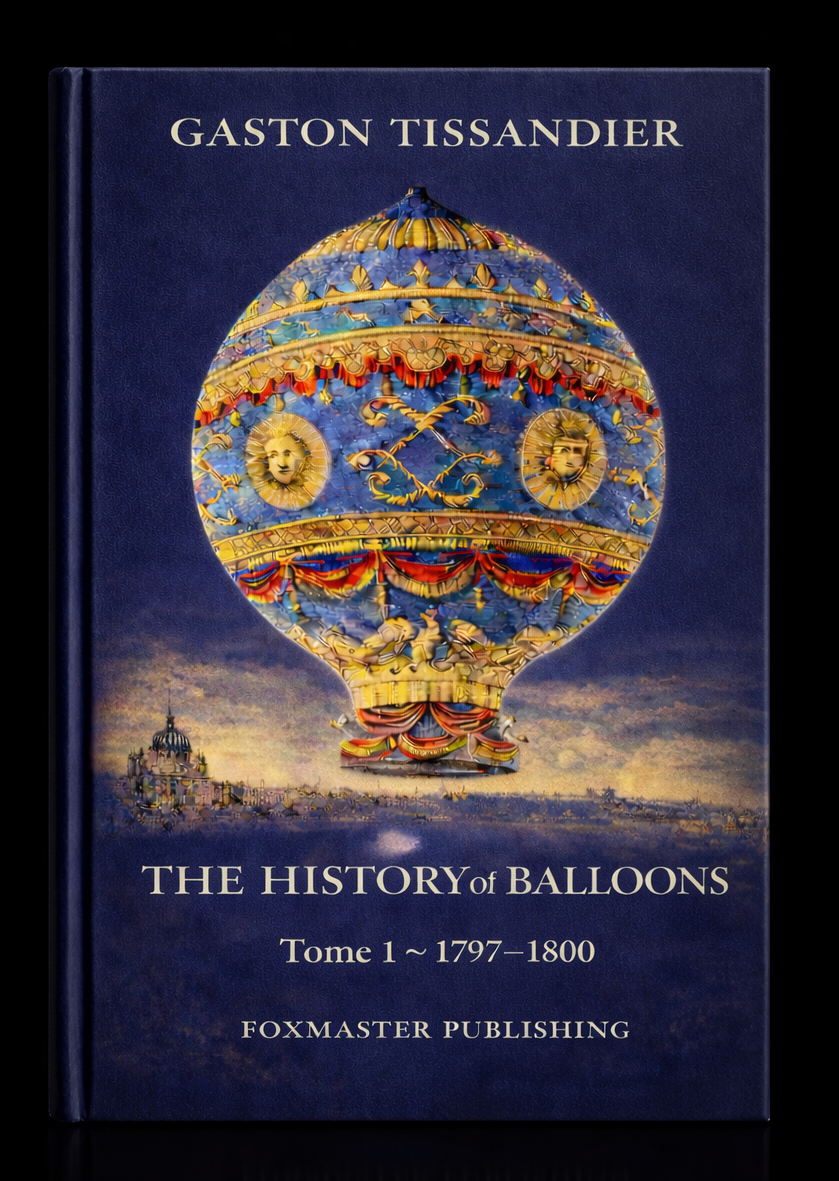
Gaston Tissandier
The History of Balloons and Famous Aeronauts
For the first time, Gaston Tissandier’s monumental Histoire des Ballons et des Aéronautes Célèbres is presented to the English-speaking world in a fully translated, critically adapted edition under the imprint of Foxmaster Publishing.
This is not a simple translation. It is a restoration, a reconstruction, and an intellectual re-anchoring of a foundational aeronautical work. Every page has been rendered with scrupulous attention to the tone, cadence, and precision of the original 1897 prose, while ensuring clarity and accessibility for modern readers. The objective has never been mere linguistic conversion, but scholarly transmission.
Central to this edition is the newly developed Lexicon — a structured analytical apparatus conceived specifically for this English release. Designed to accompany the reader from the outset, it clarifies technical terminology, identifies historical actors, and situates each reference within its broader scientific and cultural framework. Rather than forcing consultation through scattered footnotes, the Lexicon operates as an intellectual gateway, allowing the text to unfold without interruption while remaining fully contextualized.
This First Foxmaster English Edition marks the opening of a carefully curated historical series dedicated to primary aeronautical sources. It restores to circulation a work that shaped generations of writers, engineers, and historians of flight — a matrix from which countless later narratives emerged.
The publication of Volume I is only the beginning.
The ascent has begun.
Tome II is approaching.
This book is related to:
Annonay · Paris · Versailles · Lyon · Dijon · Meudon · Toulouse · Bordeaux · Marseille · London · Edinburgh · Bristol · Dublin · Vienna · Berlin · Geneva · Brussels · Rome · Madrid · Philadelphia · Benjamin Franklin · Joseph-Michel Montgolfier · Jacques-Étienne Montgolfier · Jean-François Pilâtre de Rozier · Jacques Charles · Jean-Pierre Blanchard · John Jeffries · Étienne-Gaspard Robertson · Sophie Blanchard · André-Jacques Garnerin · Jeanne-Geneviève Garnerin · Lunardi · Tiberius Cavallo · Pierre Romain · Charles Green · Sir George Cayley · François Arago · Claude-Louis Berthollet · Antoine Lavoisier · Louis XVI · Marie-Antoinette · Napoleon Bonaparte · Académie des Sciences · Société Royale · Royal Society · Champ de Mars · Château de Versailles · Tuileries Gardens · Jardin des Tuileries · Hyde Park · Place Louis XV · Palais-Royal · Seine River · English Channel · Channel Crossing